
Darts Practice
Step 1. The Throw
Practice is a great way to enjoy a
session of dart throwing, but if you really want to improve there is an important first step. You must construct your dart
throw. That is
to
say that you must decide on the mechanics that suit you, and
identify any bad habits you may already
have.
If you don't take the time to decide what is right and wrong for you, you run
the
risk of reinforcing bad habits that
will only hold you back from achieving
your goals. There definitely is such a thing as bad practice and it will result in
bad darts.
Step number one is to try and educate or (re-educate) yourself about good dart
mechanics. If you have access to video of pro-darts then try to
identify
the
things that all pro-dart strokes have in common.
There will always be
exceptions,
so make sure
that you watch several players before drawing any conclusions.
For instance, don't just analyse Phil Taylor and then copy him. The chances are that some aspects of his throw
are
unique to him and are suited to
his
physique. He may even have some bad habits. If you see a half dozen players all doing one thing the
same way, then odds are that it will
work for you.
Reference sources such as books and instructional
videos can also be helpful
but once again, try to consult several sources and identify the constants.
I feel it is important for players to make their own observations but now I will
share my views on the common threads of a good solid throw.
First of all find a comfortable, well balanced stance - not leaning over too far. The orientation of the feet to the oche is not important as long as you are
consistent. Your stance should be erect and the only movement should be in
your forearm and hand.
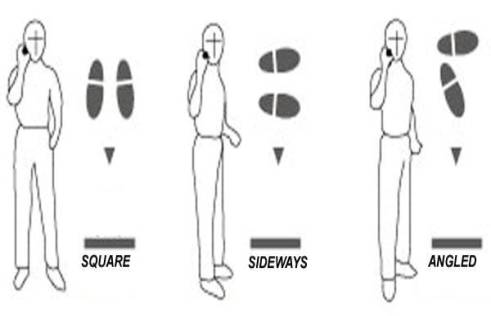
Whichever stance you pick, keep your feet planted solidly, on the floor,
and avoid lunging or lifting the
back foot off the
floor during the throw,
to get more
power. This can be a bad habit, as it affects the entire body and the throw. Lifting the foot even partway from the floor deprives the body of good balance during
the crucial moment of follow-through. The strength required to reach
the
board with any normal dart is minimal, and for best accuracy should be
provided only by the fingers, wrist, and forearm. After the dart leaves your
hand, let your hand and arm continue on towards the dartboard
Simplicity is best, so that you can more readily develop consistency
in your
throw. The elbow should be extended
fully towards the target. Really extend and stretch
the
elbow out. It may feel unnatural at first, but it is an excellent
habit to develop.
When the elbow is fully
extended, the
shoulder is by default, pulled in under the chin.
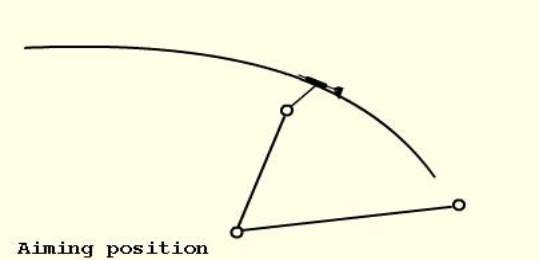
Now the dart should be brought back to the dominant eye (or between the eyes). At this point your arm has effectively become a catapult and all that remains
is to
move your arm forward and release the
dart.
At the completion
of
your throw, your arm should be fully extended as though
you
were pointing at the board.
This is called following through. Following through
is very important for helping you to establish a consistent release point.
If you really want to concentrate on your mechanics, try throwing with your
opposite hand. This
will teach
you to
be
much
more aware
of
your mechanics.
At this point you may be asking how to hold the dart? I believe that the grip
should be natural and feel comfortable.
The grip is in part determined by the equipment that is used. A good grip for a short fat dart is
not
going to be a good grip for a long skinny dart.
Normally when you purchase darts you throw them a few times to see if they feel comfortable. This is the beginning of the development of your grip. My
advice is to
concentrate on the
mechanics of your arm, ensuring that the
arm goes straight over top of the
elbow and through to full extension and let the grip
develop itself.
Missing the board or hitting the board too low often
cause beginners to
think
they
need to throw with more power. Wrong! If you think about it, missed
darts often can hit and stick in walls which are a lot harder than the bristle dartboard!
The
problem lies in the accuracy of the throw and the follow
through. Even small
children can be taught to throw accurately
without lunging or using the shoulders in a throw.
If you feel short
of
power try this:
ñ Stand upright
ñ Keep your elbow up
ñ The upper arm should be roughly parallel to the ground
This will allow you to bring your arm back further (without hitting yourself in
the
face!)
All parts of the hand should leave the dart at nearly the same time to ensure
level flight. To achieve this, make openingthe hand a positive motion, and
open the
fingers and thumb rapidly
to an extended
position, ending up
pointing at the target. This will also help keep the flights from touching the fingers as the dart leaves the hand.
As an exercise to get that quick release, imagine dipping your hand in a
bucket of paint, and
then fling it at a spot on the wall. If your hand ends up
towards the floor or ceiling, that is where the paint would have gone!
Let your fingers end up naturally
open and pointing at the exact spot where you want the
dart to go.
Remember, the early days of practice
are about developing good mechanics, so don't stress yourself
out
if your scoring isn't where you want it.
One last bit of advice on the throw may seem obvious.
Your eyes should be locked on your target.
Never aim high or low
to compensate for your throw. That is
a bad habit. Just work hard
until the darts go where you aim them.
Your first goal should be to establish good fundamentals and your results
down the road will be much better. Good mechanics allow you to continue
to throw
accurately
when you are really nervous. When you start making
successful
shots under duress, the nerves will dissipate, and your confidence will soar.
Good luck. John Part